Meet Our Animals
Get to Know the Animals of Kentucky Down Under
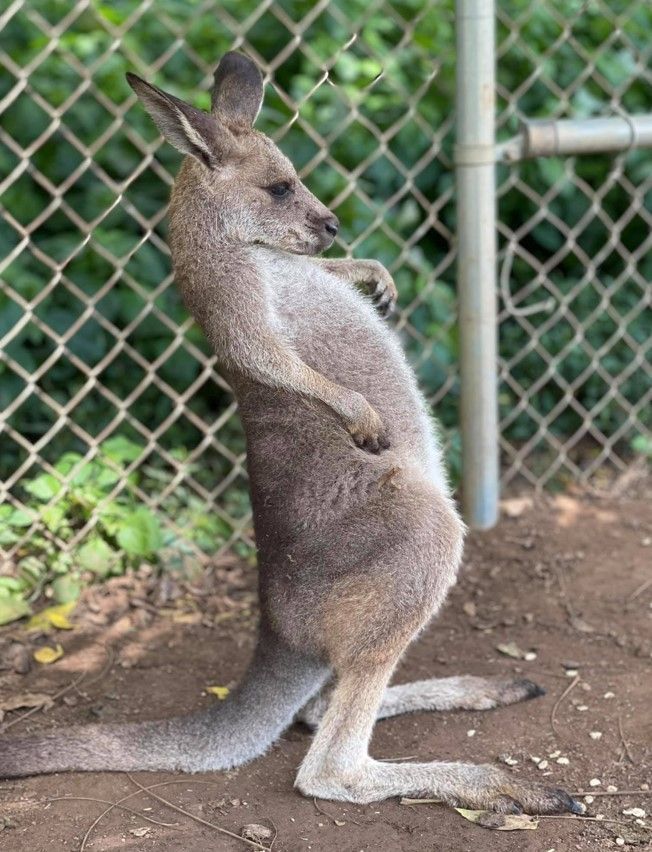
Kangaroos
Did You Know?
- Kangaroos can’t walk backward easily. Their large tails and powerful hind legs make moving backward difficult.
- A baby kangaroo is called a joey. Newborn joeys are incredibly small and continue developing inside their mother’s pouch.
- Kangaroos are built for hopping. Their strong hind legs allow them to travel quickly and efficiently across long distances.
- Their tails are incredibly strong. Kangaroos use their muscular tails for balance and support while moving.
- Kangaroos are herbivores. Their diet mainly consists of grasses, leaves, and other vegetation.
- A group of kangaroos is called a mob. Mobs can range from just a few kangaroos to much larger groups.
- Kangaroos are most active at night. Kangaroos are generally nocturnal, meaning they tend to be most active from dusk through the nighttime and early morning hours.
- Kangaroos aren’t known to carry rabies. Australia is free of classic rabies, so native Australian kangaroos do not naturally carry the rabies virus.
- Kangaroos are native to Australia. At Kentucky Down Under, you don’t have to travel across the world to meet one up close!
Lemurs
Did You Know?
- Lemurs use their tails like scarves! During colder winter weather, they may wrap their long, fluffy tails around their bodies to help stay warm.
- Lemurs are native to Madagascar. Nearly all wild lemurs are found on this island off the coast of Africa.
- Their tails help with balance. Lemurs use their long tails to help steady themselves as they climb and leap through trees.
- They’re very social animals. Many lemur species live together in groups and communicate using sounds, scents, and body language.
- Their tails aren’t for grabbing. Unlike some primates, lemurs don't have prehensile tails, so they can't use them to grip branches.
- They love to sunbathe. Ring-tailed lemurs are known for sitting upright with their arms stretched out to soak up the warmth of the sun.
Dingos
Did You Know?
- Meet Mary Kate & Ashley! Kentucky Down Under’s resident dingoes are named Mary Kate and Ashley.
- Dingoes are native to Australia. They’ve lived on the continent for thousands of years and can be found in many different habitats.
- They’re excellent hunters. Dingoes have sharp senses of sight, hearing, and smell that help them locate prey.
- Dingoes are very athletic. They can run, jump, and travel long distances while exploring their territory.
- They’re different from your dog at home. Although dingoes look similar to domestic dogs, they are wild dogs with their own unique behaviors and instincts.
- Dingoes are naturally curious. They’re intelligent animals that use their senses to investigate and understand their surroundings.
Woolshed Dogs
Did You Know?
- They have an important job! Our Woolshed dogs are specially trained to help move and guide sheep as a team.
- Herding comes naturally. Herding dogs have strong instincts that help them control the movement of a flock.
- They’re great listeners. Working dogs learn commands from their handlers using words, whistles, and other signals.
- They use more than just speed. Herding sheep requires focus, patience, quick thinking, and knowing exactly where to position themselves.
- Every dog has its own personality. Just like pets at home, working dogs have individual personalities and different ways of approaching their job.
- Dogs and handlers work as a team. Successful sheep herding depends on communication and trust between the dog and its handler.
Llamas
Did You Know?
- They’re related to camels! Llamas belong to the camelid family, along with alpacas and camels.
- Llamas communicate with their ears. The position of their ears can give clues about whether they’re relaxed, curious, or unhappy.
- Yes, llamas really do spit! They usually spit at other llamas to communicate or settle disagreements, although they may spit at people if they feel threatened or annoyed.
- They make a humming sound. Llamas hum to communicate with each other and may hum when they’re curious, content, or concerned.
- Llamas are herbivores. They mainly eat grasses, hay, and other plants.
- They’re stronger than they look! Llamas have traditionally been used as pack animals because they can carry supplies across rugged terrain.
Serval Cats
Did You Know?
- Meet Bongo, Kiara & Loki! These three spotted servals call Kentucky Down Under home.
- Servals are wild cats from Africa. They’re commonly found in grasslands and wetlands where tall vegetation provides plenty of cover.
- Those big ears serve a purpose! Their excellent hearing helps them detect small animals moving through tall grass.
- They have remarkably long legs. In fact, servals have some of the longest legs relative to body size of any cat.
- Their spots are one of a kind. Each serval has its own unique pattern of spots and stripes.
- Servals are carnivores. Their diet consists of meat, and in the wild they hunt animals such as rodents, birds, reptiles, frogs, and insects.
- They’re skilled hunters. Servals combine excellent hearing, quick reflexes, and powerful jumps to locate and catch prey.
Lynx
Did You Know?
- Lynx are built for cold weather. Their thick fur helps keep them warm when temperatures drop.
- Those big paws act like snowshoes! Their wide, furry feet help spread their weight across the snow so they can move more easily.
- Lynx are carnivores. They eat meat and hunt animals such as rabbits, hares, rodents, and birds.
- They have excellent hearing. The lynx’s sharp senses help it locate prey, even when it may be difficult to see.
- Those ear tufts are a signature feature. Lynx are easily recognized by the long black tufts of fur at the tips of their ears.
- They have short tails. Unlike many other wild cats, lynx have a naturally short, bobbed tail with a dark tip.
- Lynx are usually solitary. In the wild, they typically live and hunt alone except during breeding or when a mother is raising kittens.
Alligators
Did You Know?
- Alligators are reptiles. They’re cold-blooded, which means they rely on their surroundings to help regulate their body temperature.
- They have an incredibly powerful bite. Alligators use their strong jaws to capture and hold onto prey.
- They’re excellent swimmers. Their muscular tails propel them through the water, while their webbed feet help with movement and steering.
- Their eyes and nostrils are on top of their heads. This allows alligators to see and breathe while keeping most of their bodies underwater.
- Baby alligators can make sounds before they hatch! They make high-pitched calls from inside their eggs that help signal their mother when it’s time to hatch.
- They’ve been around for a very long time. The broader alligator lineage dates back millions of years, with ancestors living alongside dinosaurs.
Wolves
Did You Know?
- Wolves are very social animals. They live in family groups called packs and work together to raise young, defend territory, and find food.
- They communicate in many ways. Wolves use howls, growls, body language, facial expressions, and scent to communicate with one another.
- Every wolf has a unique howl. Different howls help pack members recognize and locate each other over long distances.
- They have an incredible sense of smell. A wolf's powerful nose helps it locate food, recognize other wolves, and understand what's happening in its territory.
- Wolves can travel long distances. Their strong legs and endurance allow them to cover many miles while searching for food and patrolling their territory.
- Wolves play an important role in nature. As predators, they help keep ecosystems balanced by influencing prey populations and animal behavior.
Petting Zoo Animals
Did You Know?
- Cows are very social. They form relationships with other members of their herd and often prefer spending time with familiar companions.
- Goats have rectangular pupils. Their unusual eyes give them a wide field of vision, helping them keep an eye on their surroundings.
- Goats are excellent climbers. Their specialized hooves help them balance and navigate rocky, uneven terrain.
- Both cows and goats are herbivores. Their diets consist primarily of grasses, hay, leaves, and other plants.
- Goats are naturally curious. They love investigating their surroundings and may use their mouths to explore new objects.
- Goats have four stomach compartments, too! Like cows, goats are ruminants and regurgitate partially digested food, called cud, to chew it again.
- You can meet them up close! Stop by the Petting Zoo during your visit to Kentucky Down Under to spend some time with our friendly farm animals.
Come Meet Our Furry Friends for Yourself!
There’s even more to discover at Kentucky Down Under! Come meet incredible animals, experience hands-on encounters, and learn fascinating facts along the way. Have questions before your visit? Contact our team and we’ll be happy to help you plan your adventure..